

|
|
 |
|
Week of August 30 , 2004 |
Fishing beyond the Great Lakes
Number of advisories increase, mercury pollution declines 50%
Study claims Anglers reel in more prized fish than commercial fleets
Scientists worldwide gather to discuss world's fisheries data
|
or |

Fishing beyond the Great Lakes
|
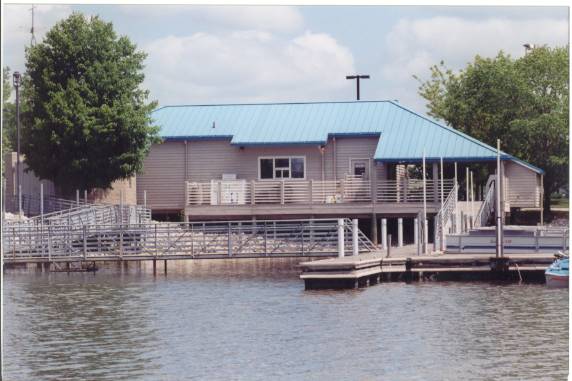
Rend Lake Resort � Rend Lake, IL for fishing, hunting and relaxation About Rend Lake - Its history For
decades the land surrounding Rend Lake was plagued by lack of water -
despite plentiful rainfall, and its location
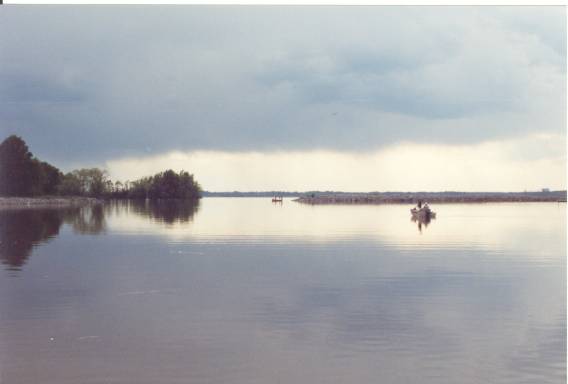
Rend Lake was built as a joint project by the Illinois Department of Conservation, the Rend Lake Conservancy District, and the U.S. Army Corps of Engineers. This 18,000 acre reservoir was built to provide a dependable domestic water supply to a two-county area beginning in 1965. Construction of the $60 million project took 5 years to complete with the final filling of the lake in the early 1970's. Since that time, many improvements have been made resulting in the current quality facilities that are currently available.
Rend Lake State Fish and Wildlife Area was developed to provide public hunting, and other recreational opportunities.
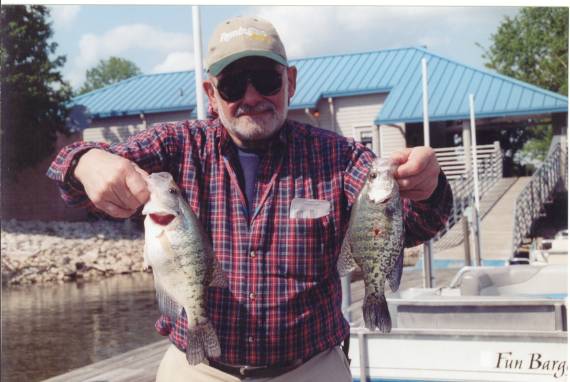
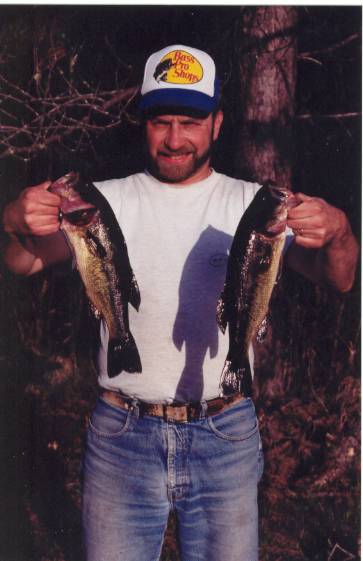
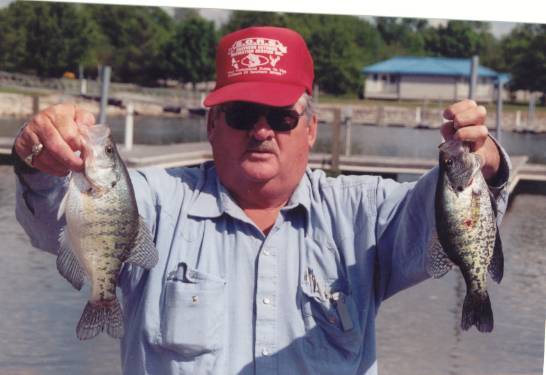
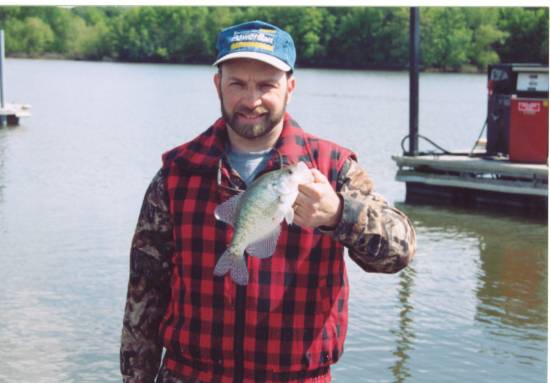
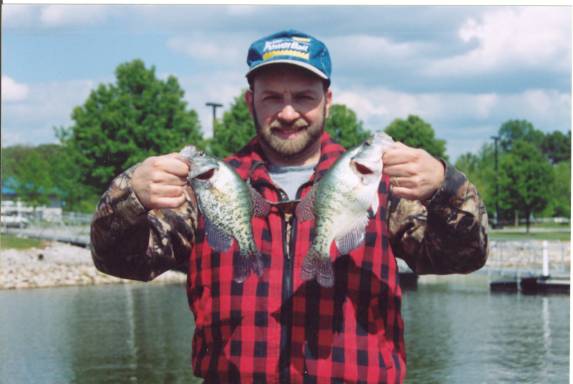
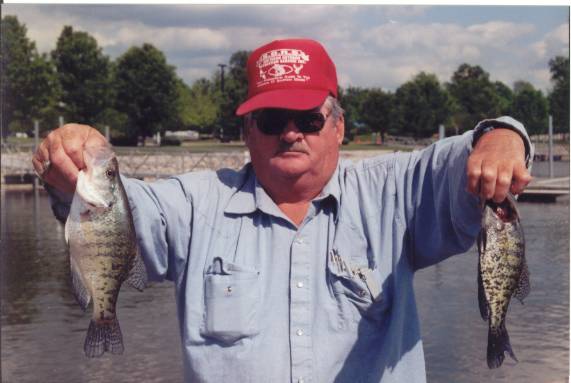
Fishing Info Rend Lake with its excellent camping, lodging and boat launch facilities, is a great headquarters for anglers. Since75 % of the park�s boundary is Rend Lake shoreline, the site provides outstanding bank fishing opportunities. The lake is well-known as an outstanding sport fishery for white and black crappie, particularly in the early spring, as well as excellent fishing for largemouth bass, channel catfish and bluegill. As a result of a DNR stocking program, the lake is one of the few southern Illinois locations to have a noteworthy white bass fishery. Current state records for bowfin and black crappie were creeled from Rend Lake.
Largemouth Bass Largemouth bass is one of the most popular species in Rend Lake. In Rend Lake, largemouth bass fishing is generally best from early April to mid-June and again from early September to mid-October when the water temperature ranges between 55 - 75�. The best spots to fish in the spring or fall are shorelines, rock riprap or shallow, brushy or weedy areas that are utilized either for spawning or protective cover.
When daytime summer water temperatures approach the 80� mark, bass generally move to the deeper, cooler water along steep banks, in river and creek channels or old pond beds and spring seeps that also have protective cover. Plastic worms, spinner baits and the deep diving plugs are the best baits to use under these conditions. However, they will move from these areas into the shoreline shallows to feed during the early morning or late evening hours, which are prime times to fish.
Crappie
Fishermen prefer using 10
to 14 ft fiberglass extension poles, cane poles or stiff action fly rods.
These are rigged with 8-12 lb test monofilament line which is strong enough
that crappie can be quickly pulled from the brush., or the wire hook
Channel Catfish
The best fishing period for
channel catfish runs from early May
Channel catfish can be
caught during the daylight hours if the water is murky or bait is worked
into a deep hole or cover where they are hiding. Channel catfish are
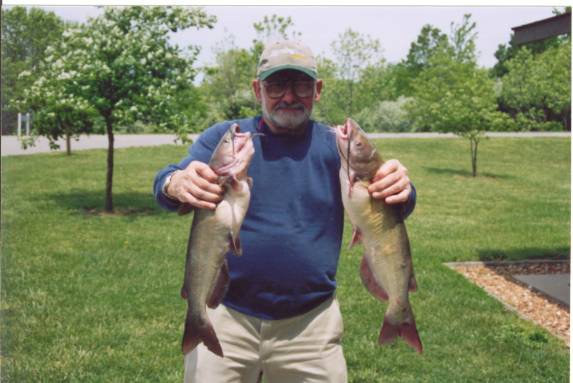
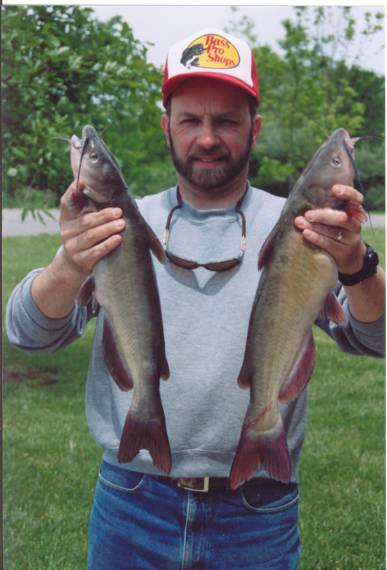
crayfish, insects and their larvae, snails, small clams, worms and fish, both living and dead. However, any bait that will give off a strong smell or taste such as cheese, blood, soured fish, clam and meat chunks, entrails and liver will also attract the attention of a hungry channel catfish.
The pole and line fishermen confine the major part of their activities to the river and creek channels, or bay and shoreline areas where there are hard mud and sand bottoms.
Hybrid Striped Bass Hybrid striped bass were initially stocked in Rend Lake in 1983 and 3-pounders were caught as early as the fall of 1985. Almost all shad-imitating plugs, spoons, and jigs are effective lures.
White Bass White bass, a species not normally found in Southern Illinois waters, were initially stocked on an experimental basis by the Division of Fisheries. They have become well established and now provide some great summer and fall angling, which has really caught the fancy of the sport fishermen.
Up to date and timely information on hunting and fishing opportunities is available 24-hours a day 365 days a year, through the Rend Lake Recreation Information Network. Weather forecasts and lake conditions are updated regularly. Information on seasonal fishing prospects and goose information, is also available. The Rend Lake Recreation Information Network can be accessed by tuning your car's AM radio to 530 kHz.
Fishing reports can also be found online at http://www.rendlake.com/pages/recreation/fishingreport.htm
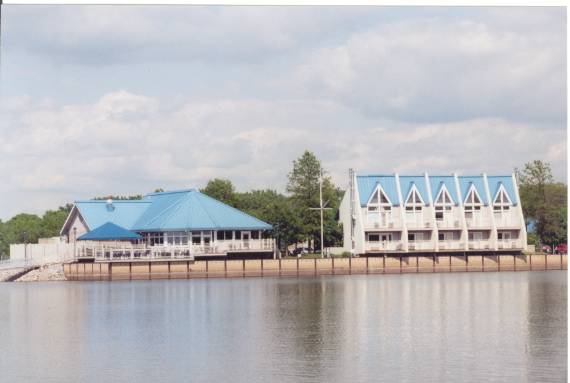
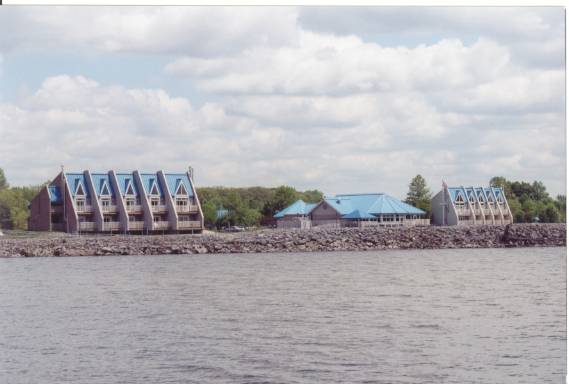
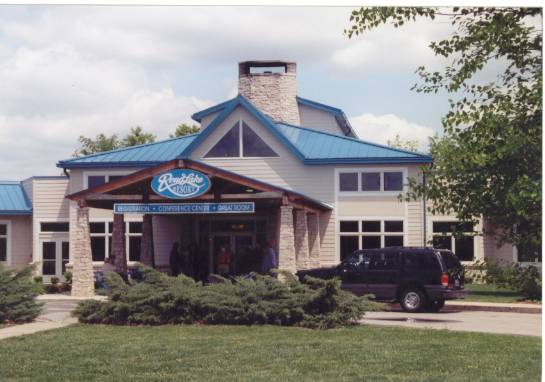
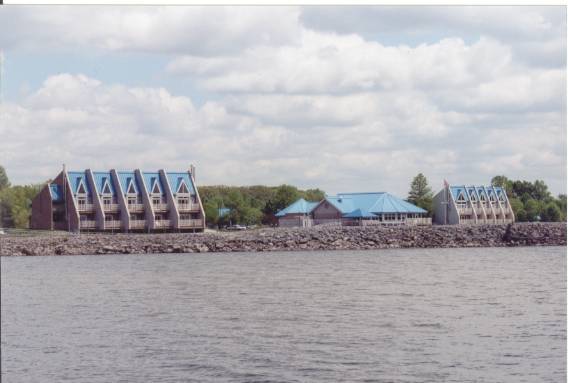
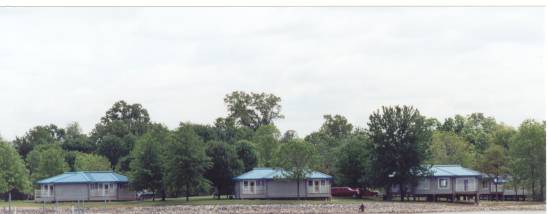
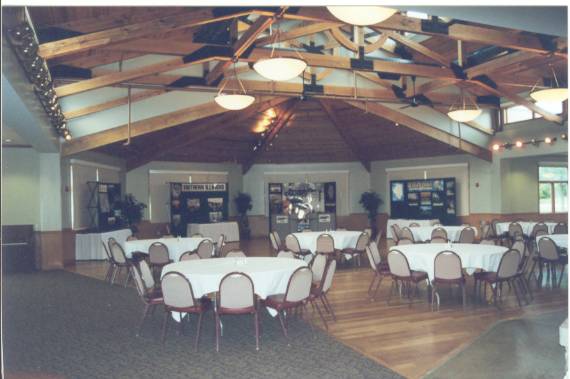
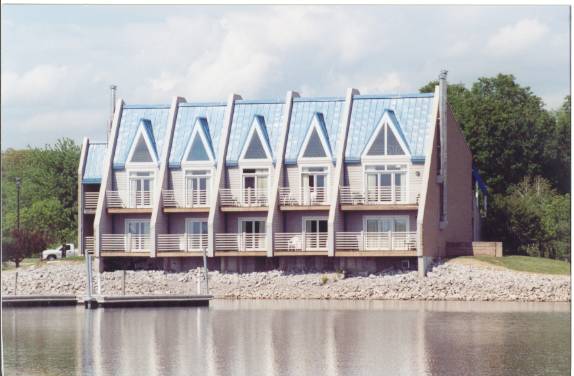
Rend Lake Resort
Offering
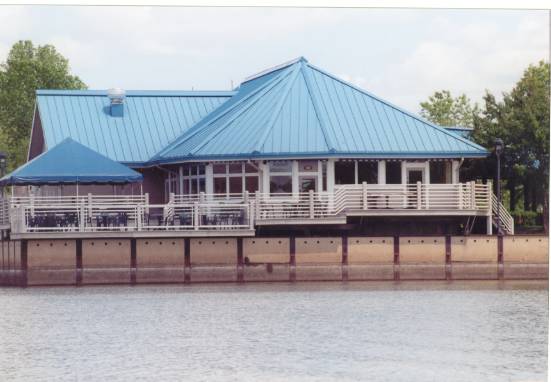
breakfast, lunch and dinner, Windows Restaurant at Rend Lake Resort
features a lounge and casual
outdoor deck dining. House specialties include pork
Amenities
include an outdoor swimming pool, tennis court, playground, golfing
packages, a convenience store and gift
Rend Lake
Resort is the location to select as your headquarters for all your
recreational activities while you�re |
Boating
Boating
enthusiasts will find easy access to Rend Lake. Within the Rend Lake State
Fish and Wildlife Area, eight of the 19 public access areas provide
launching ramps. There are also five additional ramps within the
sub-impoundment used seasonally for waterfowl hunting and a large one at
Rend
Camping Wayne Fitzgerrell has 40 tent sites to accommodate primitive campers who relish a rustic outdoor experience. Those who want a few more amenities can take advantage of the 243 modern campsites, which offer electrical hookups and sanitary facilities. Three shower buildings are available for campers.
Campers should register with the Campground Host upon arrival. The fee for camping is $15 per night for sites with electricity, or $6 per night for a primitive site. The campground remains available on a first-come, first-served basis which gives everyone equal opportunity for campsites.
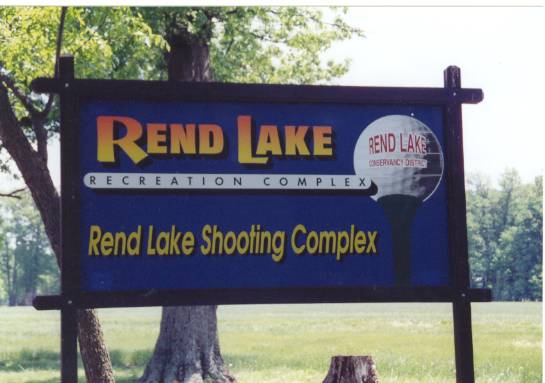
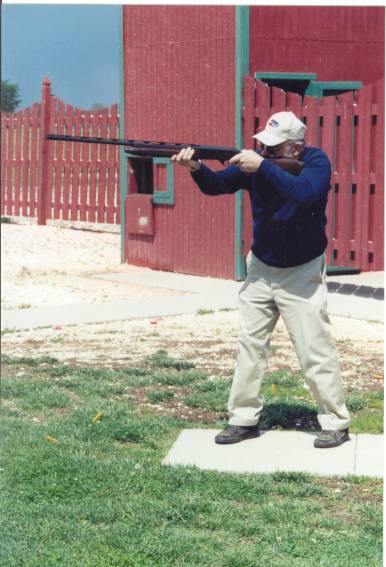
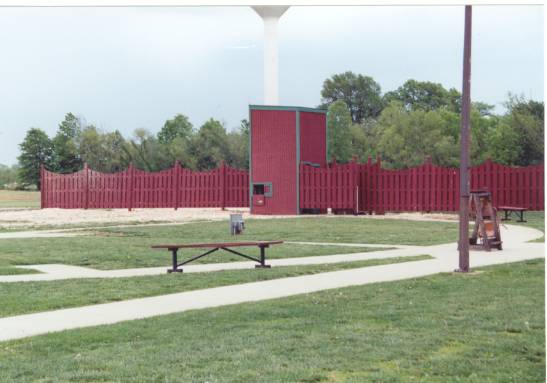
Rend Lake Shooting Complex
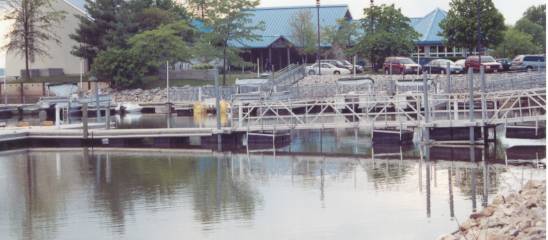
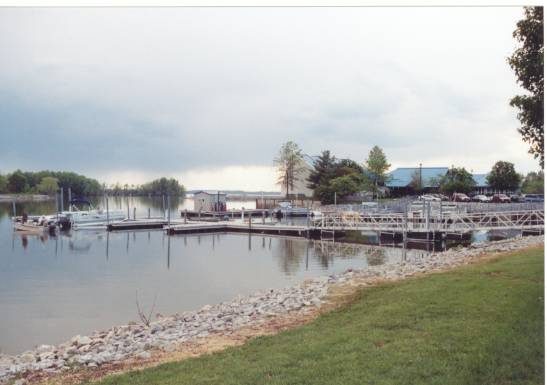
Rend Lake Marina Rend Lake Marina offers every convenience you would ever need, including fuel, boat parts, large dock & slip facility and pontoon and boat rentals.
Hunting The sub-impoundment dams across the Big Muddy River and Casey Fork Creek and the upstream areas they impound, are planted to a variety of crops and are flooded when mature for optimum waterfowl hunting. A daily drawing is conducted on site for the allocation of goose pits at the popular Whistling Wings Access Area and staked locations throughout the Casey Fork Sub-impoundment. There are also considerable acreages at high elevations that provide excellent habitat and opportunity for archery and firearm deer hunting. Another popular attraction is the annual controlled pheasant hunt held at Wayne Fitzgerrell State Park. Hundreds of upland game hunters flock to Wayne Fitzgerrell each fall to participate in a controlled pheasant hunt accommodating up to 120 hunters a day.
Available game species include: Waterfowl, quail, rabbit, squirrel, dove, deer, woodcock, furbearers, and turkey.
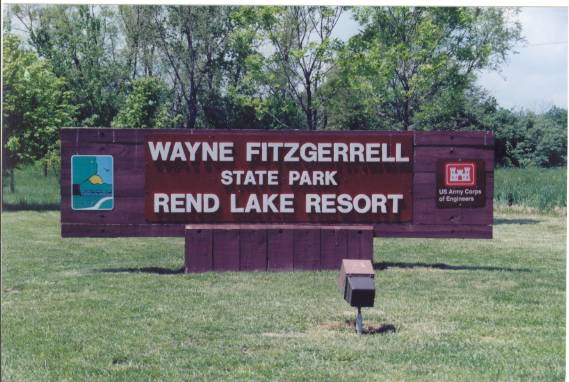
Wayne Fitzgerrell State Park Overlooking the 19,000-acre Rend Lake Reservoir, Wayne Fitzgerrell State Park has another 3,500 acres of recreation area. It is a gateway to Southern Illinois� biggest outdoor playground - a paradise for outdoor enthusiasts of all ages and interests. The park offers outstanding opportunities for hunting, fishing, camping, picnicking, horseback riding, hiking and other outdoor recreational pursuits
Dedicated in 1975, just five years after the Rend Lake reservoir was constructed, the park encompasses 3,300 acres of former farmland leased to the DNR by the US Army Corps of Engineers. The site is named in honor of the late Wayne Fitzgerrell, a state representative from nearby Sesser who was an advocate for the construction of Rend Lake.
Approximately 2,000 acres of the site are developed for picnicking, boating access, camping and other activities, while another 1,000 acres have been set aside for hunting, field trials, wildlife observation, hiking and other land uses.
The area contains many fence rows, abandoned crop fields and cleared farmsteads interspersed with small oak-hickory woodlands. Three quarters of the site�s perimeter is Rend Lake shoreline. This varied topography provides excellent habitat for a variety of upland and woodland wildlife, as well as waterfowl, shorebirds and raptors.
Day Fees A day use fee of $2.00 per day is collected at designated Corps of Engineers boat ramps. Day use fees also apply to swimming (must be paid before swimming) at the North Marcum and South Sandusky beaches. Standard fees are $1.00 per person with a maximum charge of $3.00 per car. Children, 12 and under, are admitted free to the beach. An annual day use pass for boat ramps and beaches may be purchased at Corps of Engineers offices for $25.00. Persons with a Corps of Engineers camping permit are exempt from day use fees on any date for which the permit is valid. Golden Age and Golden Access Discounts apply to day use fees.
Driving time Convenient Interstate access makes getting to Rend Lake a snap. .Drive time from St. Louis is 1.5 hours, from Chicago it�s 5 hours .
For more information on hunting, fishing and golfing packages or to make lodging reservations, call 618-629-2211 or 800-633-3341.
Lake and Dam Demographics: Shoreline length�...162 mi Pool length................13 mi Pool Width..................3 mi Maximum depth�......35 ft Average depth...........10 ft Surface area�...24,800 acres
Contact information
Rend Lake Resort 800-633-3341 http://www.rendlakeresort.com/
Fishing Reports http://www.rendlake.com/pages/recreation/fishingreport.htm
U.S. Army Corps of
Engineers 618-724-2493 Located at the east end of the Main Dam Road
Wayne Fitzgerrell State Park Illinois DNR
11094 Ranger Road 800- 633-3341 http://dnr.state.il.us/lands/Landmgt/PARKS/R5/WAYNE.HTM
Rend Lake Marina
8955 West Dam Lane http://www.rendlakemarina.com/
Illinois Department of
Natural Resources
Illinois DNR State Fish and Wildlife Area http://dnr.state.il.us/lands/Landmgt/PARKS/R5/RENDLAKE/
Rend Lake Marina
8955 West Dam Lane http://www.rendlakemarina.com/
Illinois Department of
Natural Resources
Illinois DNR State Fish and Wildlife Area http://dnr.state.il.us/lands/Landmgt/PARKS/R5/
Rend Lake Shooting Complex
Rt. 3, Box 242 Just off Interstate 57 at Exit 77 http://www.rendlake.org/shooting/
Other Important Phone #s
|

Support Services
|
M&M Taxidermy - Madison, Wisconsin M&M Taxidermy is a husband and wife run business. They have been involved in taxidermy for over 12 years. Proprietor Mark Wiggen is a member in good standing with the Wisconsin Taxidermist Association, the International Taxidermy Association and the International Guild of Taxidermy. The husband and wife team attend as many of their seminars and mini courses as possible. This keeps them on the cutting edge of the industry and allows them to offer their clients the latest and greatest in techniques and supplies available.
M & M Taxidermy will give you a quality mount to display with |
pride for years to come. They offer quality mounts for fish, birds and mammals with superior service. Re-live "the moment" with an M&M mount. Conveniently located on Madison's west side, they are a short drive from any of the Madison lakes.
M&M Taxidermy 4509 Windigo Tr. Madison, WI 53711 608-288-FISH (3474) http://www.great-lakes.org/wi-taxidermy.html |
|
Pulaski, NY Bait & Tackle shop All Seasons Sports
All Seasons Sports
specializes in both lake and river tackle for
Find multiple major and custom brands of fly rods, reels, lines, accessories, as well as a full-line of flies and fly-tying materials, comprising over 7,000 items for every fly-fishing application. We carry a full stock of lake tackle for trout, |
walleye and salmon including dodgers, flashers, teasers, spoons, and cut-bait rigs � in thousands of different size and color combinations. All major lake tackle brands including Pro-Troll, Rhys Davis, Challenger, Hot Spot, O�ki, Spin Doctor, Rapala, Mustad, Eagle Claw, Gamakatsu, Shakespeare, and Raven, among hundreds of other brands. Full line of ice fishing gear. Bait casting, spinning and float rods and reels from all major makers and custom makers. Hodgeman Pro Shop; Pro-Troll 5Star Dealer; Cortland Pro Shop; and Shimano Top Shelf Dealer.
All Seasons Sports, Inc. Captain James B. Dence, proprietor 3733 State Route 13 Pulaski, NY 13142 http://www.great-lakes.org/ny-bait&tackle.html 315-298-6433 Ph/fax |
National
|
Help Protect the Great Lakes - Your help is needed We need your financial help to fund the operations of the Illinois Waterway electronic barrier � to prevent Asian carp and other nasty critters from entering our lakes
A second larger, longer-life barrier is now under construction, but the cost of the design exceeds available funds by $1.8 million.
Illinois has contributed $2 million to the project, but the other Great Lakes Governors say they are not able to contribute the balance � $1.8 million. Their states do not have the money. The need for the additional $1.8 million is critical.
Contributions from any non-federal source will help. That�s where clubs, individuals and corporate America can help
Use of Contributed Funds Funds will be held by the Great Lakes Sport Fishing Council and distributed based on the direction of a board of non- |
agency trustees including the president of the GLSFC.
All contributions are tax deductible and will only be used to:
1) Implement the Asian Carp Rapid Response Plan 2) Improve or operate Barrier I 3) Construct and operate Barrier II
Send your donations to: GLSFC � carp fund P.O. Box 297 Elmhurst, IL 60126
Or use our PayPal for credit card donations. Go to www.great-lakes.org/carp
For more information and photos go to:
Thanks for your help in preventing the invasion of these harmful critters into our lakes. |
|
Asian Carp and other invasive species are approaching the Great Lakes via the Chicago Sanitary and Ship Canal. You may have seen video clips of these jumping fish on TV. Though humorous to watch, these large plankton-eating fish have the potential to wreak havoc on the Great Lakes ecology and commercial and recreational fisheries. Although it is unlikely they would be come abundant in the middle of the lake, they almost certainly would do well in near shore areas, river mouths and shallow productive bays. Not only would this add an undesirable component to the ecosystem but these fish add an element of personal risk to boaters and others using recreational watercraft. We must do whatever we can to keep these fish out of the Great Lakes.
The electric fish barrier in the Chicago Sanitary and Ship Canal stops the passage of large fish. The U.S. Army Corps of Engineers built this as a temporary project with only a three-year life span. The electrodes in this barrier are expected to wear out in about April 2005. Asian carp have been captured only 22 miles downstream of the barrier. We have a monitoring plan in place to determine the leading edge of the Asian carp population as they move closer to the barrier site and are working on a rapid response plan to kill the fish if they begin to accumulate in number below the barrier.
A second larger, more powerful barrier has been designed and construction will begin in July 2004. However, the cost of the barrier design to stop Asian carp from entering the lake exceeds the available funds by $1.8 million. We need funding to help support construction of the barrier and to help pay for the rapid response plan if it has to be used.
We Need Your Help to Protect the Great Lakes The Second Barrier A second larger, longer-life barrier is planned for construction in July 2004. The cost of the proposed design, which has been recommended by the Dispersal Barrier Advisory Panel, exceeds the available funds by $1.8 million. The U.S. Army Corps of Engineers program under which the project is being constructed limits the federal contribution to the project to $5 million.
The State of Illinois has already contributed $2 million to the project and it will be difficult to obtain the entire balance from a single entity. Governors of most of the other Great Lakes do not feel they are able to contribute the balance of the funds at this time, yet the timing of these additional contributions is critical. If the funds can not be secured the cost of construction will increase by 30% or more and we will not have the two-barrier system needed to prevent small Asian carp from entering the Great Lakes until the second barrier is complete.
We are applying to other sources for the needed funds, but every contribution from any non-federal source will help. |
Asian Carp Rapid Response A Rapid response Committee has developed a Rapid Response Plan to address the presence of Asian carp in the Chicago Sanitary and Ship Canal if they begin to congregate below the existing barrier before the second barrier is constructed.
The Asian Carp Rapid Response Plan would involve eliminating Asian carp from 5.5 miles of the Sanitary and Ship Canal. Current estimates for implementation of the plan place the cost at about $450,000. There are 18 agencies involved in the response planning effort but none of them has the funds to enact the plan if it is needed. Funding for the plan is not covered in any Congressional Act or other agency mission. The response plan is a vital action which must be used if the carp appear in the Canal before Barrier II is in place.
We need your financial support to help keep Asian carp out of the Great Lakes. The most immediate need is to gather enough money to make the rapid response happen if it is needed. The large-scale response if needed would most likely occur this summer or fall. Once Barrier II is online the response would be scaled back to treat the 1000 foot distance between the barriers if fish were found between the barriers.
The second use for the funds would be to maintain and improve Barrier I. Barrier I will still be needed after Barrier II is built. We need your help to ask Congress to extend that authorization indefinitely and to provide the Corps with the directive to construct improvements to Barrier I. These improvements would increase the effectiveness of Barrier I and the service life of the project. Right now, the Corps of Engineers does not have the authority to operate Barrier I after September 2004.
Use of Contributed Funds The collected funds will be held by the Great Lakes Sportfishing Council and will be distributed based on the direction of a board of non-agency trustees including the executive director of the Great Lakes Sportfishing Council. All contributions are tax deductible and 100 percent of the contributions will be used towards Asian carp prevention. Contributions will be used to:
1) 1)Implement the Asian Carp Rapid Response Plan 2) 2)Construct Barrier II 3) 3)Improve or operate Barrier I
The funds will not be used for agency labor or overhead and will not be used for research. Collected donations will be used to pay for barrier construction, carp control chemicals or if absolutely necessary, for operating expenses of the barrier.
|
|
Country-wide number of advisories increase, mercury pollution declines 50% USEPA Releases 12th Annual state issued data of National Listing of Fish Advisories (Washington, D.C. � August 24 - For the 12th straight year, EPA has released its summary of information on locally-issued fish advisories and safe-eating guidelines. This information is provided to EPA annually by states, territories and tribes. EPA makes this information easily accessible to the public each summer on its website at: http://www.epa.gov/waterscience/fish/ .
EPA does not draw conclusions or identify trends from this National Listing. EPA's role is to provide a central repository. Each State determines the scope and extent of monitoring, how to decide which waters should be placed under advisory, etc., thus the information is highly variable and difficult to draw conclusions or trends.
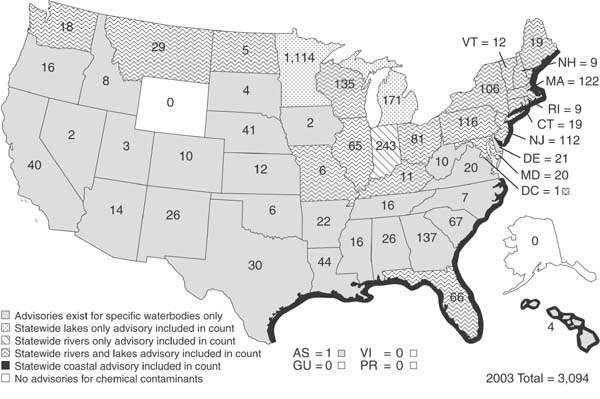
Minnesota continues to issue more warnings about eating recreational-caught fish than any state in the country, 1,114 or about 36% of the 3,094 total national number of advisories. See map below that reflects the wide disparity of advisories between states.
Although the number of fish consumption advisories continue to increase each year, it is widely acknowledged contaminants and pollution continue to decline. PCBs are no longer manufactured and man-made mercury has declined 50 % since 1990. The science community has developed increasingly sophisticated research and laboratory equipment that can isolate reveal more minute particles giving them samples they were unable to retrieve a few short years ago. Data that used to be reported in parts-per-million (ppm) are now often stated in parts-per-trillion (ppt).
EPA believes that the
increase in advisories is primarily due to increased and more sophisticated
sampling of previously untested waters by states and tribes and not due to
increased levels or frequency of contamination.
|
protective
for children and pregnant women,�� said
For most
people, the risk from mercury by eating fish and shellfish is not a health
concern. Yet, some fish and shellfish contain higher levels of mercury that
may harm an unborn baby or young child's developing nervous system.
Therefore, the Food and Drug Administration (FDA) and the EPA recently
advised women who may become pregnant, pregnant women, nursing mothers, and
young children to avoid some types of fish and eat fish and shellfish that
are lower in mercury. (
http://www.epa.gov/waterscience/fishadvice/advice.html )
Human-caused
mercury emissions in this country have dropped 50 % since 1990,
and the Bush Administration is in the process of regulating mercury
emissions from coal-fired power plants for the first time in our nation�s
history. The final rule, which will be promulgated by March 15, 2005, will
be one component of the Agency�s overall effort to reduce mercury emissions
domestically and internationally.
Total Number of Fish Consumption Advisories - 2003
|
|
Study claims Anglers reel in more prized fish than commercial fleets New �study� disputes National Research Council data WASHINGTON � Millions of casual fishers reel in a higher take of the United States' most prized saltwater fish than previously thought, researchers say, prompting them to urge improved regulation of recreational fishing. Nationally, recreational fishers landed 5% of fish over the last two decades, more than double previous estimates, says a report in Friday's issue of the journal Science. But they took 23% of fish whose numbers are shrinking.
Scientists urged the government to slow the decline of over-fished species. They said current regulations have done little to constrain recreational fisheries, which deplete some major fish populations even more than commercial fisheries. The Recreational Fishing Alliance, with 90,000 anglers nationally, said it would fight more regulations. It argued the researchers' conclusions were based on flawed data.
Felicia Coleman, a Florida State University researcher and co-author of the report, said the data shows recreational fishers |
landed more than half the catches of some fish populations. They caught 93 % of red drum caught in the South Atlantic, 87% of bocaccio snagged off the Pacific coast, and 59% of red snapper landed in the Gulf of Mexico, according to the report. Bocaccio is a type of West Coast rockfish.
However, Jim Donofrio, executive director of the New Jersey�based Recreational Fishing Alliance, questioned the reliability of the report's conclusions and data. For example, he pointed to a reported 35 % jump in summer flounder catches. In reality, he said, torrential rains had kept anglers onshore, and the catches had dropped by 35%.
"We'll accept regulations. That's not a problem. But we will fight restrictions based on arbitrary data and inaccurate data," Donofrio said.
The number of saltwater-dwelling fish who recreational and commercial fisheries get to catch are based on a 1999 study by the prestigious National Research Council. It estimated that recreational fisheries haul in just 2 % of fish landings. |
|
Scientists worldwide gather to discuss world's fisheries data Madison, Wisconsin hosts 134th annual American Fisheries Society conference Over 1,750 scientists and aquatic experts from 30 countries gathered last week on the beautiful shores of Lake Monona in Madison for the 134th annual conference of the American Fisheries Society. Everything from Asian carp and black bass tournaments to biodiversity issues in far-away places like Africa and Russia, took center stage.
Much the same as we have been reporting hereon our �Weekly News� segment, many conference presentations were about studies or management practices that showed concerns of declining numbers of Pacific salmon, the growing size of the "dead zone" in the Gulf of Mexico, global warming, overfishing by commercial fishermen and the rising threat of invasive species.
Even so, largely because of better management practices that offer pro-active initiatives rather than re-active after the fact responses to ecosystem issues, many fish chiefs such as Minnesota�s Ron Payer and Wisconsin�s Mike Staggs believe their state�s fish stocks are in better shape today.
Payer, said �we�re looking into our walleye creel and size limits statewide in view of an increase in harvest that we need to respond to. We plan to propose some reduced size and number limits especially in the Rainy River � Lake of the Woods area to protect that superb fishery.� The Rainy River already has a large and growing recreational sturgeon fishing program, again largely through pro-active management practices. Those management policies include closed and catch-and-release seasons and minimum creel limits.
"The magnitude of the problems are increasing," Staggs said, because the population is growing and people are moving to areas where nature is not accustomed to them. Staggs also referred to the major problem invasive species pose to our ecosystems and fish stocks.
Wisconsin�s state capital, located in Madison is practically across the road from the Monona Terrace Convention Center where the AFS conference was held. The 3/8� mile wide beltway of land separating Monona and Mendota lakes contains some pleasant lakefront city and state parks, the State Capitol building, Executive mansion, Alliant Energy and Convention Center, Madison Children�s Museum, Obrich Gardens and the U. of Wisconsin-Madison campus.
Restaurants and lodging facilities abound in the area, and being in a prime high traffic area, most all require reservations. As the area is known for its German ethnicity, one restaurant that we frequented was the Essen Haus Inn just east of the conference center. See contact info below.
Lake Mendota offers some excellent fishing for muskie, northern pike, bass and yellow perch. While you�re out targeting your favorite species, you can put up the family at a |
nice place like the Marriott Madison West where they can enjoy the sights and sounds of a classy facility with pleasant trappings, a swimming pool, good food and won�t care how long you stay out. It�s also the place for a quiet getaway from the hustle and bustle of your hectic routine.
Madison, a unique location for spending a few leisure days visiting the state�s capital, dining out, fishing and just relaxing and vacationing in the shadows of big city living and a pastoral setting.
Alliant Energy Center
1919 Alliant Energy Center
Way 608-267-3976 http://www.alliantenergycenter.com/
The Marriott Madison West 1313 John Q Hammons Drive Middleton, WI 53562 608-831-2000 888-236-2427 www.jqhhotels.com/htmlsite/hotels/wi/middleton or http://marriott.com/property/propertyPage.mi?marshaCode=MSNWE
Madison Convention & Visitors Bureau 615 East Washington Avenue Madison, WI 53703 800-373-6376 608-255-2537
608-258-4950 FAX
Monona Terrace Convention Center
One
John Nolen Drive
Wisconsin Department of Tourism 201 West Washington Avenue
PO Box 8690 800-432-8747 608-266-2161 http://www.wistravel.com/madison.htm
Essen Haus Inn 514 East Wilson Street Madison, WI 608-255-4674 |
Canada
|
Delays hit firearms registry redesign - No new computer system two years after deal signed Firm that designed faulty original is still on payroll OTTAWA - A stream of reviews and government-ordered changes has delayed the final redesign of the federal gun registry. The firm that designed the faulty original firearms registrations computer system is still on payroll.
Chief Firearms Commissioner Bill Baker acknowledged that a 15-year contract to redesign and replace the old Canadian Firearms Registration computer system still has not delivered a new system, two years after it was awarded. "That's a contract under development. That's not in place yet. We're still operating on the existing Canadian Firearms Registration System," said Baker.
Instead, EDS, the company that designed the original ineffective computer database � criticized by the auditor-general as expensive and out-of-date � is still on the payroll. Baker said in February that EDS had been paid $165 million over a seven-year period to develop and manage the system. That contract was increased on May 10 to $182.5 million and extended for up to 16 months, said Thomas Vares, a |
spokesperson for the Canadian Firearms Centre.
"The money that EDS gets is for the continued support for the information system that runs the program right now. It's an annual support payment charged to keep that machine running," said Baker. The replacement contract was awarded in July, 2002, to Team Centra, a joint venture between CGI Group and BDP Business Data Services, to design and operate a new computer database and, pending government approval, to take over delivery of the service to the public.
It was originally said to be worth $300 million � $34 million to design the new system, and $266 million to operate it over 15 years, and by July, 2003, had ballooned to $371.56 million, according to documents obtained last year by Conservative gun control critic Garry Breitkreuz.
"Whatever technical requirements remain, we know they are part of an overall budget that is going down in cost annually," said Alex Swann, a spokesperson for Public Safety Minister Anne McLellan. Auditor-General Sheila Fraser said that the original EDS-designed system was too complex and hard to adjust as government policy decisions changed. |
Regional
|
Weekly Great Lakes Water Levels for August 27, 2004 Current Lake Levels: Currently, all of the Great Lakes are higher than the levels of a year ago. Lakes Superior, Michigan-Huron, St. Clair, and Erie are 5 to 12 inches higher than last year. Lake Ontario is currently 1 inch above last year�s level. Lakes Superior, Michigan-Huron, and St. Clair, however, are still below their long-time averages by 5, 11, and 3 inches, respectively. Lake Erie is currently at its long-time average level and Lake Ontario is 2 inches above average.
The Lake Superior outflow through the St. Marys River into Lake Huron is expected to be near average during the month of August. Flows in the St. Clair and Detroit Rivers are expected to be below average. The Niagara and St. Lawrence River flows are projected to be above average for the month of August.
Temperature/Precipitation Outlook: A frontal system will push into the Great Lakes basin Friday. |
With the muggy air still in place, showers and thunderstorms are expected to build along the front. Some of the storms may be severe. Lingering showers are forecasted through the weekend before conditions dry out for the start of the workweek.
Forecasted Water Levels: Lake Superior is approaching the end of its seasonal rise and is expected to remain steady over the next month. Lakes Michigan-Huron and St. Clair will continue their seasonal decline and are expected to drop 1 and 4 inches, respectively, over the next month. Lakes Erie and Ontario will continue their seasonal decline, dropping 5 and 8 inches, respectively, over the next month.
Alerts: Users of the Great Lakes, connecting channels and St. Lawrence River should keep informed of current conditions before undertaking any activities that could be affected by changing water levels. Mariners should utilize navigation charts and refer to current water level readings. |
|
Great Lakes basin earns grants to fund fish/wildlife restoration The USFWS recently announced the granting of $566,256 to fund fish and wildlife restoration projects in the Great Lakes basin.
The projects will be funded under authority of the Great Lakes Fish and Wildlife Restoration Act of 1998, which provides assistance to the Great Lakes Fishery Commission, states, tribes and other interested entities to encourage cooperative conservation, restoration and management of fish and wildlife resources and their habitat in the Great Lakes basin.
The nine approved projects focus primarily on the rehabilitation of sustainable fish populations and include the study of various species of fish, their reproduction, distribution, movement, diet and habitat use within the Great Lakes ecosystem.
One project will examine the population dynamics and biology of the siscowet strain of lake trout in Lake Superior; another project will develop genetic management guidelines for lake sturgeon; another will assess the status of aquatic habitat in the Lake Huron-Lake St. Clair-Lake Erie corridor; and another will test a potential new method for treating ballast water to prevent the transport of invasive aquatic species.
Project proposals are developed and sponsored annually by States and Tribes in the Great Lakes region in response to a request for proposals from the Great Lakes Fishery Commission and the Service. The Council of Lake Committees, a 21-member body representing State, Tribal and Canadian Provincial agencies, recommends proposals for funding to the Service Director.
Project funds will go to Michigan State U, the U of Wisconsin-Milwaukee, the Great Lakes Fishery Commission, the U of California-Davis, Ohio State U, the U of Maryland-Center for Environmental Science and the Ohio DNR. The Service contributes up to 75 % of the cost of the projects, with |
matching funds this year coming from project recipients..
When it was passed, the Great Lakes Fish and Wildlife Restoration Act authorized $4.5 million annually for State and Tribal grants through 2004. Since 1998, 58 restoration projects totaling more than $5 million, including $2.8 million in federal funds, have been implemented. More than 60 organizations have contributed matching funds and expertise.
Projects have focused on rehabilitation of fishery resources and aquatic habitat to benefit species such as lake trout, walleye, yellow perch, brook trout, lake sturgeon and freshwater mussels. One of the most important outcomes of funded projects has been the development of state-of-the-art geographic information systems that will eventually cover the entire Great Lakes basin and allow agencies to better prioritize and focus restoration activities.
Project and funds recipients are: � Dynamics and biology of siscowet lake trout in Lake Superior -- Michigan State University � Lake trout reproduction at Mid-Lake Reef -- University of Wisconsin-Milwaukee � Biophysical model of Lake Eric walleye recruitment -- Michigan State University � Quality control of proposals -- Great Lakes Fishery Commission � Development of genetic management guidelines for lake sturgeon -- University of California, Davis � Huron-Erie corridor system habitat assessment -- The Ohio State University � Food habits of Lake Ontario offshore prey fish -- Great Lakes Fishery Commission � Evaluations of pilot-scale venturi oxygen stripping to prevent ballast water invasions -- University of Maryland Center for Environmental Science � Assessment of pit tags for estimating exploitation of walleyes in Lake Erie and Saginaw Bay -- Ohio Department of Natural Resources
|
|
Headline �Lake Huron alewife population crashes� misleading An August 6, 2004 by noted editor could well be misleading Many weird and uncomfortable phenomenon are going on in our lakes and streams, some of which we can control � if our political leaders listen and fund projects to protect our aquatic resources.
Unintentional introductions of Asian Carp are knocking on Lake Michigan�s door, zebra mussels and 178 other invasive species have invaded the Great Lakes to impact our ecosystem and our beloved recreational fishery. Of the eight states and province that have a major presence in the region all are feeling a cash crunch that is impacting fisheries management programs. For an alewife population to �crash� in any of the Great Lakes would require a series of catastrophic actions that have taken place that literally destroy spawning habitat and adult year classes that are incapable of reproducing in future years.
It is widely acknowledged that the presence of zebra mussels and predator diaporeia have taken a toll on the bottoms-up food chain, impacting the body mass of Chinook salmon and other predator species in Lake Huron. The spring reports of the USGS lake surveys at the annual lake committee meetings of the Great Lakes Fishery Commission reflected these reports of declines in alewife populations, their year classes and the associated body mass of Lake Huron�s |
major predators. But to say the major forage base of that lake has �crashed� is a bit of a stretch in semantics.
This is not to say we should not be concerned with what is going on in our lakes and with our aquatic resources. Invasive species are the single most important factor now addressing our environment. The International Joint Commission admits as much. However, Lakes Michigan and Ontario have both been through pretty much the same scenario and are presently being exposed to the same ravaging factors affecting aquatic resources as is going on in Lake Huron. But Lakes Michigan and Ontario are surviving and doing pretty well with generating a good year of fishing.
Witness two recent records
coming from those lakes. Lake Ontario gave up a new state record steelhead
on August 14, when the fish of a lifetime hit Rob Wilson�s
Pirate 55 spoon � a 31 lb, 3 oz steelhead trout that stretched
the tape to 39" long. And in Lake Michigan on Monday, August 23, an Iowa
angler caught a state record brown trout, 40 �� and 36.56 lbs, on a J-Plug
in shallow water off Algoma. Our lakes are more resilient than we seem to think.
As Bill Parker acknowledged with a quote in his article: �Although the alewife population is in decline, (USGS Scientist) Schaeffer said it could turn itself around. Alewives are very prolific.� |
|
EPA Chief tours Great Lakes region USEPA administrator Mike Leavitt is traveling the Great Lakes region to learn about environmental issues impacting the lake's surrounding communities as a result of President Bush's Great Lakes Executive Order that puts Leavitt and the EPA in charge of coordinating the lakes' water clean up efforts of local and state governments, tribes and nongovernmental organizations.
Last week Leavitt toured Wisconsin's Fox River in Green Bay |
with local environmental protection officials and city government representatives to learn about the site that he said will undergo the largest dredging project the federal agency has seen. They toured brownfields, talked with city planners and saw parts of the river being tested for depth in preparation for dredging.
Bush has not proposed new funding but has directed Leavitt to coordinate 140 federal programs addressing the lakes. |
|
Water rises in U.S. Great Lakes after near record low CHICAGO � Great Lakes water levels have rebounded from near record lows thanks to months of heavy rain, providing a boon to boat owners, swimmers, and fish, scientists said recently. Rising a foot from 45-year lows last year, the five Great Lakes have reversed a six-year, 3-ft drop that exposed broad stretches of beaches, left marinas high and dry, and bent propellers.
With 18 %of the world's fresh water, the lakes satisfy the thirst of 45 million North Americans and sustain more commercial shipping than the Panama and Suez canals combined, but the |
low levels hampered ship traffic. After several mild winters that increased winter evaporation rates and reduced the snow pack, water levels rose following heavy rains last fall and a once-in-a-century deluge in May. But that rainfall was an anomaly.
"That's what's worrisome," said NOAA hydrologist Cynthia Sellinger. "What made the lakes rise this year was we had an extremely wet fall and a wet May. What usually gives us a good rise in the lake is ice cover to prevent evaporation in winter, and then a nice snowpack melting in the spring thaw," she said. |
General
|
The modern definition of a racist: someone who is winning an |
argument with a liberal." |
|
Groundbreaking paves way for new Bass Pro Shop
Pearl,
Mississippi--
State and
city officials, project developers
|
top industry names and at value prices. The store is tentatively scheduled to open late October 2005.
The store in Pearl will offer some of the same signature features of other Bass Pro Shops Outdoor World stores such as museum quality wildlife exhibits, a waterfall and a large freshwater aquarium filled with native fish species. However, as typical in stores in other geographic locations, the Pearl Bass Pro Shops Outdoor World will be uniquely designed to pick up the local flavor of the area�s outdoor heritage and include state record fish and wildlife mounts and historical pictures and artifacts from local hunters and fishermen. |
|
New Bass Pro Shop opens September 2nd in Myrtle Beach Offers sights, Sounds of South Carolina low Country Myrtle Beach, South Carolina-- Located at U.S. Highway 17 and Kings Highway in the Colonial Mall, the new Bass Pro Shops Outdoor World Myrtle Beach opening is scheduled for September 2nd.
This 102,000 sq-ft sportsman�s paradise lives up to its claim of bringing the outdoors, indoors. A special feature is the 11,000 gallon saltwater aquarium that treats viewers to a colorful scene of spade fish, black drum, redfish, jack crevalle, red grouper and a host of other fish native to South Carolina waters. A nearly 12,000-sq-ft Islamorada Fish Company Restaurant, another Bass Pro Shops operation, will also be located in the store and will open in late October. The restaurant will offer an exterior canopy for dining and include a bar, saltwater aquarium, sushi bar and see-thru fireplace, surrounded by water.
From the minute visitors step onto the foot bridge that transports them across the newly landscaped pond, that just happens to run the complete length of the store, they know they are in for something special. Surrounded by lush vegetation and flanked by numerous palm trees, this water feature offers rock seating to view special demonstrations. Local masons have used large boulders of all shapes and sizes deposited in farm fields during the glacier period to build the front entrance. Massive steel trusses frame the Grand Entrance.
Old fishing relics--boats, rods, reels, canoes and creels - indigenous to Horry County - adorn the walls. The floor inside the retail store is unique as well. Masonry artists have carved |
various animal tracks into the stained concrete flooring. In front of the aquarium is a full-sized impression of the bones of a prehistoric sea turtle.
Giant, exquisitely crafted wildlife chandeliers, made by Bass Pro Shops own artisans, hang throughout the store. Area hunting and fishing record mounts are displayed alongside local archival historical prints depicting early South Carolina residents enjoying sporting adventures.
Various murals, like the one of Murrells Inlet, created by renowned artist Linda Spencer, grace the walls of the store. Another scene, painted by her husband Roberto Regalado, puts the viewer right on the race car track at Darlington. It is so real you can almost smell the rubber, hear the roar of the engines and feel the heart-pounding excitement that is NASCAR�.
Other scenes depict an underwater sea experience located in the fishing tackle department. Here a visitor feels as though he is standing on the bottom of the ocean looking up at schools of fish that pass silently overhead.
Of special interest to local racing enthusiasts will be a NASCAR� department with lots of memorabilia, commemorative hats and licensed clothing. A NASCAR� simulator will provide hours of fun for adults and kids alike.
The area�s largest selection of fishing, nature, and marine items will be featured along with a full line of Tracker and Nitro boats, America�s number one aluminum and fiberglass fishing boats, which will be displayed in the store�s 7,000 sq-ft boating center. |
Illinois
Gov vetoes self-defense gun billSPRINGFIELD �Illinois Gov. Rod Blagojevich on August 20 vetoed legislation that would bar municipalities that prohibit guns from charging residents if they use their weapons in self-defense within the confines of their home.
The measure had passed the Legislature overwhelmingly and backers of the proposal said they have the votes to override the governor's veto this fall. "This is a shameless repudiation |
of the commitments the governor made in his run for office two years ago when he said legitimate gun owners had nothing to fear from this administration," said Sen. Ed Petka (R-Plainfield), the measure's lead sponsor.
The bill was drafted after Wilmette resident Hale DeMar was charged with violating Wilmette's gun ban when he shot an intruder in his home last Dec. 29. Before the village finally dropped charges, DeMar faced a $750 fine. |
|
Waterfowl Seasons set for 2004-2005 SPRINGFIELD, ILL. - Waterfowl hunters in Illinois will see a 60-day duck hunting season statewide, along with 86-day Canada goose seasons in the north and central zones and a 54-day Canada goose season in the south zone in recommendations forwarded to federal wildlife officials for the 2004-2005 waterfowl season, Illinois DNR Director Joel Brunsvold announced.
The seasons proposed by Illinois are submitted to the USFWS for concurrence. Final rules establishing season |
dates, bag and possession limits and shooting hours will be published in the Federal Register in late September.
The Department�s Natural Resources Advisory Board approved the recommendations after conducting a series of public meetings in each zone earlier this month. The season dates and bag limits adopted by the board and approved by Director Brunsvold are the same as those proposed by Department staff last month, except the dates for the first segment of Canada goose season in the south zone will be Nov. 13-14. |
Indiana
|
Indiana's 23rd state park opens Museum, prairies, wetlands make park unique Gov. Joe Kernan officially opened Prophetstown State Park as the 23rd in Indiana's park system on August 24. "While continuing the best traditions of the state park system, Prophetstown offers a unique experience for visitors with its rolling prairie landscape," Kernan said. "This park, with the wetlands and lake, will become a great attraction for birders and other wildlife watchers.
Prophetstown State Park, located between I-65 and the Tippecanoe and Wabash Rivers near Battle Ground, kicked off its grand opening week with hikes, music and family activities on Saturday Aug. Facilities opening this week include picnic areas, a hiking trail and a paved bicycle trail. A 100-site campground will open next spring. Future development will include expansion of the campground, a youth tent area and extension of the main road and bike trail, opening up the large northeastern section of the park to the public.
High river bluffs, wetlands and unique wet slopes, called fens, make up the landscape of the park. Prophetstown also lies at the edge of a historic ecosystem characterized by rich soil, prairie grasses and colorful wildflowers.
"Visitors will feel the vast size of the park as they discover the |
expansive views," said DNR Director John Goss. "And this, right now, is less than a third of what the park will become. We currently own about 1,700 acres, not all of which will be accessible until next spring. The planned purchase area of the park will exceed 3,000 acres."
A unique feature of the park is the Museum at Prophetstown, operated by a private, non-profit group dedicated to preserving and interpreting woodland Native American and Wabash River valley agricultural history, culture and traditions. The museum has restored more than 100 acres of spectacular prairie, is re-creating a Native American village and has built a 1920's era living history farm. Admission to the museum is $5 for adults and $3 for children aged 3- to 18-years old. For more info go to: www.prophetstown.org
The park gate is off Swisher Road. From the intersection of Interstate 65 and state Route 43, head south three-tenths mile toward Lafayette on Route 43 to Burnetts Road, left on Burnetts Road to Ninth Street Road, and right on Ninth Street Road to Swisher Road. Turn left and proceed about 2 miles on Swisher Road to the park entrance.
Prophetstown State Park Web site: http://www.in.gov/dnr/parklake/parks/prophetstown.html |
Ohio
|
Opening Day for Ohio's Hunters is September 1 COLUMBUS, OH - September 1 is the opening day of hunting season for squirrel, mourning dove, Canada goose and teal in Ohio, according to the ODNR Division of Wildlife.
"Many people look forward to opening day and the start of a new hunting season," said Steven A. Gray, chief of the Division of Wildlife. "It is this anticipation that excites hunters, both youngsters and veterans, to another season afield. I encourage Ohio's hunters to take a friend this year and introduce them to hunting."
The Division of Wildlife predicts hunting for doves and Canada geese will be excellent this year. Squirrel hunting should be very good - especially in eastern and southern Ohio. Teal hunting success will depend upon the early migration of these small ducks, but the best hunting for teal will be in the western Lake Erie marshes and some of the larger inland |
wetlands.
Hunting in Ohio is not only an opportunity for special moments, but also a great recreational bargain. A hunting license for an Ohio resident, good for one year, costs only $19. Participants in waterfowl hunting must also purchase a federal Duck Stamp, along with an Ohio Wetlands Habitat Stamp, at a cost of $15 each. These licenses and permits can be purchased at any of more than 1,300 license vendors in the state, or online at www.ohiodnr.com .
Detailed information on these and other upcoming hunting seasons can be found in the 2004-05 Ohio Hunting Regulations (Publication 85) available where hunting licenses are sold, online at www.ohiodnr.com or by calling 1-800-WILDLIFE
|
|
Sea lamprey returning to Lake Erie Reports at the just finished American Fisheries Society show that sea lamprey populations are expanding in Lake Erie's tributaries. Anglers are finding and increasing number of |
lamprey attached to steelhead, along the nearshore waters of the lake. Ohio DNR Lake Erie supervisor Roger Knight reports Sandusky and Fairport Harbor biologists have been betting the reports from boat anglers. |
|
Ohio to hold public meeting to discuss draft agreements to protect the Great Lakes Sept 14 Comments sought on water management proposals by the Great Lakes states and provinces COLUMBUS, OH - A public meeting to discuss proposed agreements to manage and protect waters of the Great Lakes basin will be held at Geneva-on-the-Lake on Tuesday, September 14. The Ohio DNR will host the meeting, which begins at 6:30 p.m. at the Geneva State Park Lodge and Conference Center, 5888 State Rte 534, Geneva-on-the-Lake. ODNR officials will explain the draft agreements, take questions and offer opportunities for public comment.
On July 19, the eight Great Lakes governors and the premiers of Ontario and Quebec announced a 90-day public review period for agreements created to update the way the Great Lakes and the waters of the Great Lakes basin are managed and protected. The agreements will implement Annex 2001, a supplementary agreement to the Great Lakes Charter that was adopted by the governors and premiers in June 2001.
The draft Annex implementing agreements are the result of three years of effort by a state/provincial working group to address Great Lakes Basin protection issues ranging from water consumption to diversion. During the review period that extends until October 18, the draft agreements are available for the public and all interested groups to read and make comments. The draft documents are available at www.ohiodnr.com .
Specific protective measures in the draft implementing agreements include:
● A commitment that conservation and information programs will be put in place and maintained in all the Great Lakes states, Ontario and Quebec; ● A commitment to use a uniform, resource-based decision making standard in evaluating future proposals for new or increased water uses; |
● A commitment to a collective decision making process for future proposals for regionally significant new or increased water uses; and ● A requirement that all future new or increased diversions and regionally significant water uses in the Great Lakes Basin result in an improvement to the basin's ecosystem.
During the 90-day comment period, public meetings are being held throughout the Great Lakes region to explain the agreements and elicit public comment. In addition to the session at Geneva-on the Lake on September 14 and two meetings held earlier this month in Toledo, public meetings scheduled for Ohio include:
September 21 2:00-4:00 p.m. and 6:30-8:30 p.m. Cleveland/Akron Area Brecksville Community Center One Community Drive - Brecksville
September 22 6:30-8:30 p.m. Norwalk/Sandusky Area Huron Cty Dept of Job & Family Services 185 Shady Lane Drive - Norwalk
September 23 2:00-4:00 p.m. Findlay ODNR Division of Wildlife District #2 Office 952 Lima Avenue - Findlay
September 29 2:00-4:00 p.m. Columbus Ohio DNR - Assembly Center, Bldg. E 2045 Morse Road - Columbus
The public may also comment before October 18 by writing to Annex Comments, ODNR Division of Water, 1939 Fountain Square Court, Bldg. E., Columbus, Ohio 43224 or by e-mail to [email protected] . Once the 90-day period is complete and public comments have been taken into account, the agreements will be refined and presented to the governors and premiers for their final approval and signature.
|
Wisconsin
|
Hook and line sturgeon season opens Sept. 4 POYNETTE, Wis. -- Wisconsin's 2004 statewide hook and line lake sturgeon season opens on Saturday, Sept 4 and runs through Oct 15. Anglers are allowed to harvest one legal sized fish per season.
To fish for lake sturgeon a free, sturgeon angler tag needs to be obtained from any outlet that sells Department of Natural Resources fishing licenses. If an angler catches a legal size fish and wishes to harvest it, the angler tag needs to be immediately applied to the fish, then taken to one of following registration stations by 6 p.m. the next day for registration.
Hook-and-line fishing for sturgeon takes place primarily on major inland rivers, such as the Chippewa, Flambeau, and lower Wisconsin, and on Lake Wisconsin, which is an impoundment of the Wisconsin River in Sauk and Columbia counties. Hook-and-line sturgeon fishing is specifically prohibited on other river systems, such as the Upper Wisconsin (above the Wisconsin Dells dam), and portions of the Fox, Wolf, St. Croix, Namekagon, as well as the Lake Winnebago system, where a sturgeon spearing season is held during February.
There is a seasonal fish refuge on the Chippewa River from a point 1,000 ft below the Jim Falls Dam downstream to the County Highway Y bridge in Chippewa County. The refuge, posted with "No Fishing" signs, makes it illegal to take, disturb, catch, capture, kill or fish for any fish in a posted area. The refuge � encompassing the entire river channel from the main spillway of the Jim Falls dam downstream to county Highway Y and closing the area to all fishing -- was developed to protect adult female lake sturgeon.
Anglers should check the current Guide to Hook and Line |
Fishing Regulations for waters that are specifically closed to sturgeon fishing, and for more rules intended to help protect populations of this ancient fish, which have been cruising Wisconsin waters for more than 100 million years.
State law establishes alternating minimum length limits of 50 and 70� every other year on the Wisconsin River downstream of the Wisconsin Dells dam and on the Menominee River in northeastern Wisconsin, which is a Wisconsin-Michigan boundary water. The minim size is 50� in odd number years and 70� in even years, so this year�s limit on these waters is 70�. Other waters in the state open for hook and line sturgeon angling have a 50� minimum size limit annually.
With the 50-inch limit in place last year, there was a record harvest of 72 fish below the Sauk dam. Monitoring data shows that 60% of the angler catch since 1999 on Lake Wisconsin and below the Dells is comprised of fish less than 30�, which indicates young fish are being recruited into the population. Less encouraging news is that the sex ratio of harvested fish shows continued disproportionate harvest on the larger female fish, thus the need for conservative management of this rare fishery."
DNR personnel caution that possession of an illegal or untagged sturgeon is a crime and may result in a fine of $3,000, a mandatory three-year revocation of all DNR licenses and possibly up to 90 days in jail. It is also illegal to catch a sturgeon for someone else to tag or possess the tag of another person. Anyone who knows of illegal or untagged sturgeon being taken is asked to call the DNR Hotline at 1-800-847-9367 (1-800-TIP-WDNR) or contact the local conservation warden or Sheriff�s Dept. All information will be kept confidential. |
|
Advisory team formed to help develop tournament fishing rules MADISON � An advisory group has been formed and met for the first time Aug. 28 in Stevens Point to help the DNR carry out new legislation requiring the agency to develop rules regulating fishing tournaments and to determine which four bass tournaments will participate in a pilot study to evaluate the effects of culling, or sorting fish.
Group members included representatives from the ranks of tournament organizers, fishing clubs, the sport fishing industry, the tourism industry, the general angling public, and other users of Wisconsin lakes and rivers, according to Mike Staggs, who leads the Department of Natural Resources Fisheries Management and Habitat Protection program.
�Over the long term, this advisory group and the subsequent rulemaking process will allow us to address all of the concerns we�ve heard over the years with fishing tournaments, including one of the most common complaints, overcrowding at boat ramps on tournament days,� Staggs says.
In the short term, the group will help DNR carry out the new law�s provision concerning bass tournaments, Staggs says. The 2003 Wisconsin Act 249, in addition to requiring DNR to promulgate rules to regulate fishing tournaments, requires the agency to establish a bass fishing tournament pilot program.
Under the pilot program, DNR is required to issue four permits per year to bass tournaments to evaluate the impact of culling. The Wisconsin BASS Federation and participating tournaments will share the cost of the evaluation, and DNR is required to report back to the Legislature before the pilot program expires Dec. 31, 2006.
�The advisory group will help us develop the process for deciding which bass tournaments will be in the pilot program, and they�ll set the standards for livewells that we think are critical to allow the culling to occur safely,� Staggs says. |
Under Wisconsin�s rules, anglers can only have five bass in their livewells at one time, and when they reach five, they�re done bass fishing for the day. In many other states, anglers can keep fishing and replace smaller fish in their livewell with bigger fish.
Hundreds of fishing tournaments occur in Wisconsin every year, with bass tournaments among the most popular. DNR now issues free permits to tournaments that meet certain criteria, including if competition is the primary intent, if prizes valued at $500 or more are awarded for competition, if participants number more than 40 individuals or 20 boats and if participants are required to fish the same dates. Tournaments that don�t meet all of the criteria do not need a permit.
In recent years, the DNR has issued about 400 total permits annually, with about 250 of them for bass tournaments. The permits set general conditions for all permitted tournaments, and then can set conditions specific to an individual tournament. For example, a permit may identify areas where competitive fishing is prohibited to protect critical habitat, or to protect public rights, interests or safety, including designated swimming areas, mooring areas, and navigational channels.
The advisory committee will examine the current permit system and consider changing it. But that process will take many months. The first task on the advisory group�s agenda is helping DNR draft proposed rules setting standards for the livewells that participants will need to have in the four pilot program tournaments next year.
�If bass are held in a good livewell that�s aerated all of the time, their chances of survival after being carried around all day will be better,� the DNR says.
For more info, contact Patrick Schmalz, warmwater regulations specialist [email protected] , 608-266-8170 |
Home | Great Lakes States | Membership | Exotics Update | Great Links
Pending Issues | Regional News | Great Lakes Basin Report | Weekly News / Archives
Web site maintained by JJ Consulting